Slack Response-Time Norms for Remote Teams
How to set realistic Slack response expectations so your team can stay responsive without living in chat all day.
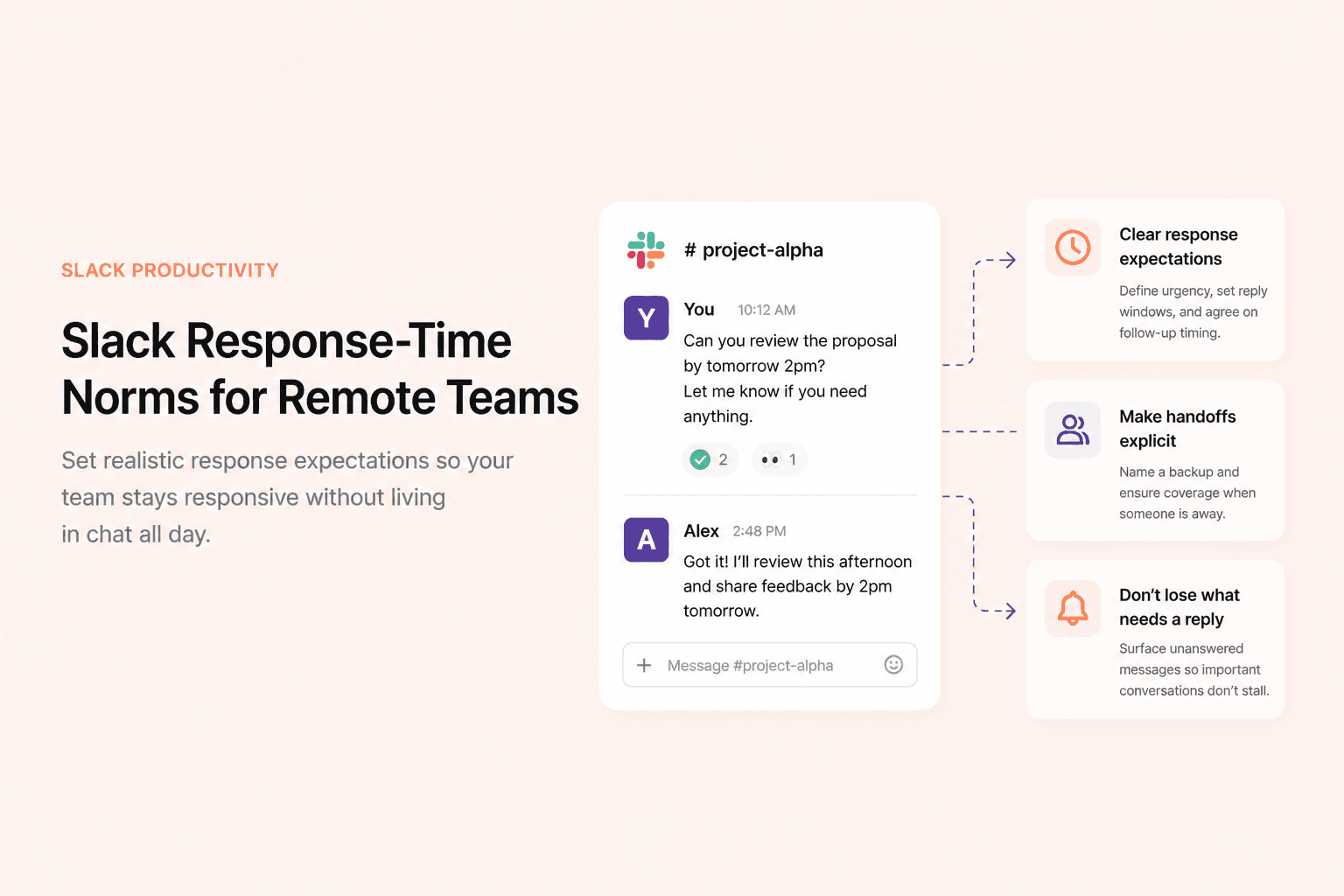
Most remote teams do not have a real Slack response-time policy. They have a pile of assumptions. One person thinks "urgent" means five minutes. Another thinks the same message can wait until the afternoon. A third person is trying to do deep work and feels guilty every time Slack lights up.
That mismatch is expensive. It creates friction, unnecessary follow-ups, and a constant feeling that everyone is either too slow or too distracted. Clear norms fix far more of that than teams expect.
What response-time norms actually do
Good norms do not force everyone to answer instantly. They reduce uncertainty. People know when to expect a reply, when to follow up, and when a different channel is more appropriate. That clarity is what keeps Slack useful instead of exhausting.
1. Define what counts as urgent
If everything is urgent, nothing is. Write down what truly deserves an immediate interruption: production incidents, customer escalations, or same-day blockers. Everything else can follow your normal async rhythm. This is the most important rule because it protects both focus and trust.
2. Set default reply windows by channel type
Different conversations deserve different expectations. A team operations channel might target same-half-day replies. Project discussion threads might target replies by the next working block. Low-priority channels might not need any time guarantee at all. Once those defaults exist, far fewer people feel like they need to monitor Slack continuously.
3. Put deadlines in the message, not in your head
If you need a decision before 2pm, say that in the message. The person reading it cannot prioritize correctly based on your private urgency. Clear timing transforms a message from ambient background noise into a visible workflow request.
4. Agree on when a follow-up is appropriate
A team norm like "follow up after four working hours for same-day blockers and after one business day for standard questions" removes a lot of interpersonal tension. People stop guessing whether a reminder is too early or too passive. The rule makes the follow-up feel normal.
5. Make handoffs explicit when someone is offline
Response-time norms fall apart when availability changes and nobody adjusts the workflow. If someone is out, deep in meetings, or working another timezone, the team needs a visible backup path. Otherwise the message just sits there while everyone assumes someone else owns it.
remindo
Want Slack to resurface unanswered messages automatically?
remindo tracks unanswered questions, mentions, and supported follow-up flows inside Slack.
See how remindo works →Where policies alone are not enough
Norms reduce ambiguity, but they do not solve the operational problem on their own. People still forget. Threads still get buried. Mentions still create visibility without closure. The more important the conversation, the less you want the system to rely entirely on human memory.
- A teammate can agree with the norm and still miss the message after a meeting block.
- A thread can technically be followed and still go stale with no reply.
- A message can be visible to the right people and still never get the response it needs.
The operating model that works
The best remote teams combine clear expectations with a lightweight safety net. The expectations define what good behavior looks like. The safety net catches the conversations that still stall anyway. remindo is built for that second layer: in channels where it is installed, it can resurface unanswered questions, mentions, and supported follow-up flows so the team does not have to depend entirely on memory and manual chasing.
That is the balance worth aiming for. Slack should support focused work, not compete with it. Once the norms are explicit and the follow-up layer is reliable, response times stop being a source of stress and start becoming a predictable part of how the team operates.
